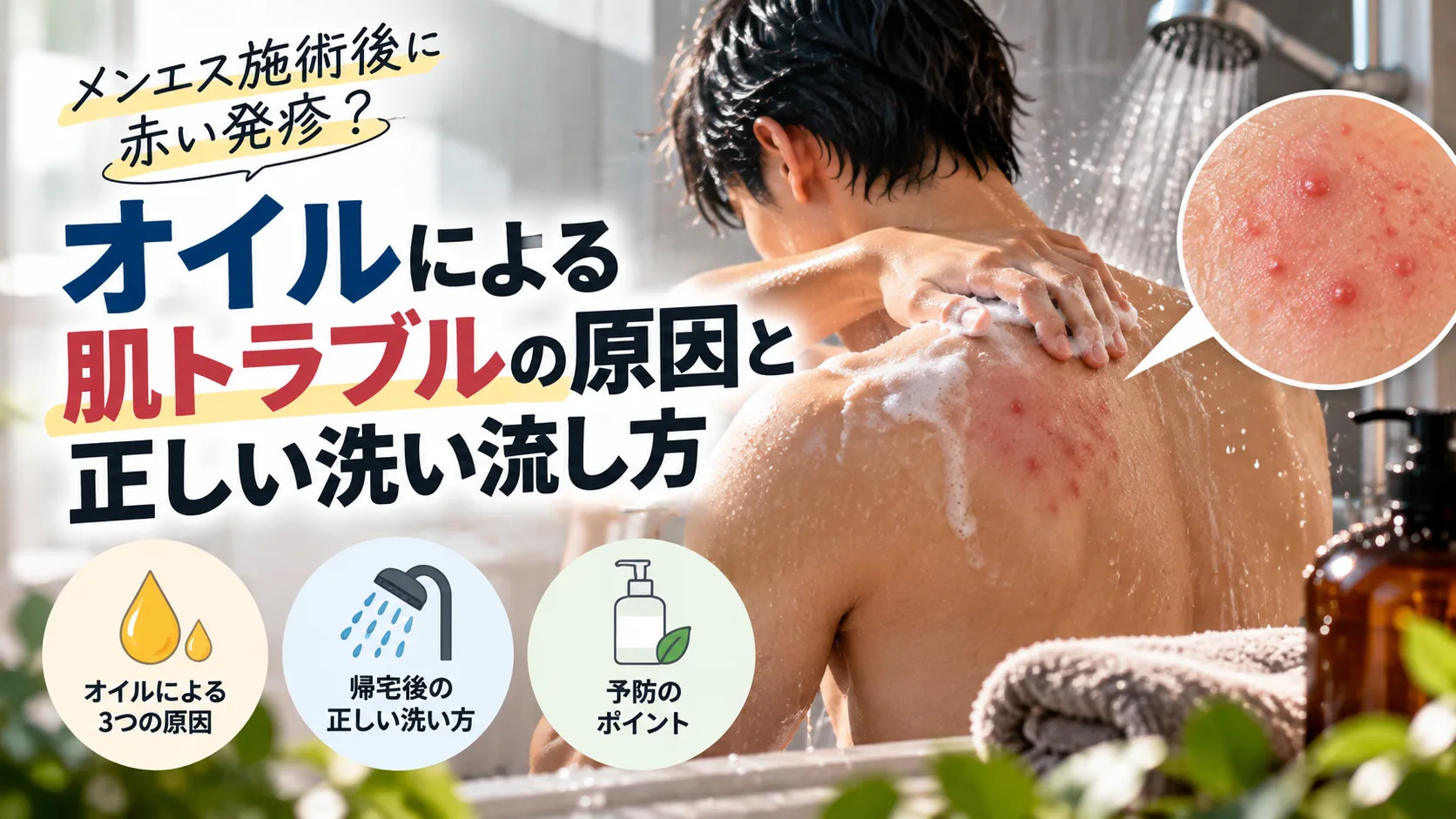
Red Bumps After a Men's Esthe Treatment? Oil-Related Skin Trouble and How to Rinse It Off Properly
Why a treatment can leave red bumps on your arms or legs, covering clogged pores from leftover oil, contact dermatitis from oil ingredients, and oxidized oil. Includes the right way to rewash at home and prevention tips.
What was updated
Added guidance on choosing a body wash.
What this article covers
Ever been surprised by red bumps on your arms or legs after a treatment, and wondered if you just didn't rinse off well enough? This article covers:
- The three likely causes of oil-related skin trouble
- Why it's worth showering again once you get home
- How to wash properly and reduce the risk
This article includes editorial opinion
What follows isn't a dermatological diagnosis or treatment — it reflects general information our editorial team has researched. If symptoms persist, or you have significant pain or swelling, please see a dermatologist rather than treating it yourself.
Short answer: there are three likely causes, not just leftover oil
Leftover oil clogging your pores is said to be one major factor behind post-treatment bumps, but it's not the only one — contact dermatitis from the oil's ingredients, and oxidized or degraded oil, can also play a role.
The likely causes
1. Clogged pores from leftover oil (folliculitis-like bumps)
Oils commonly used at men's esthe salons — mineral oil, heavier carrier oils, water-soluble oil — are said to form a film that clings to the skin's surface. If it isn't rinsed off thoroughly, the leftover oil can mix with sweat and sebum and clog pores. Bacteria can then multiply there, which is said to be linked to red bumps resembling folliculitis. Sweat-prone seasons, and areas like the arms and legs where clothing sits close to the skin, are said to be especially prone to this.
2. Contact dermatitis from oil ingredients or fragrance
The oil itself, or the essential oils, synthetic fragrance, or preservatives used to scent it, can trigger redness or itching if they don't agree with your skin. Redness, itching, or a fine rash are said to typically appear anywhere from a few hours to the next day after treatment. If your skin is already dry, or its barrier is weakened from something like razor irritation, a stronger-than-usual reaction is said to be more likely.
3. Oxidized or degraded oil
Depending on how a salon stores and manages its oil, prolonged exposure to air and light can cause it to oxidize. Oxidized oil is said to be more irritating to skin, and can cause redness or a stinging sensation even on otherwise healthy skin.
Should I shower again once I get home?
Yes, showering again once you're home is a good idea. A salon's shower time is often limited, and the cleansing products provided aren't always strong enough — it's said to be common for more oil to remain on the skin than you'd expect.
Why rewashing at home helps
- The salon shower may not fully emulsify the oil: oil is said to need a good amount of lather and warm water to properly emulsify and rinse away. A quick rinse under time pressure can leave a thin film behind.
- Oil left on skin oxidizes further over time: oil remaining on the skin is said to keep oxidizing as time passes, and oxidized oil is more likely to irritate skin and worsen redness.
- Friction from clothing can push oil deeper into pores: getting dressed and moving around with oil still on your skin is said to risk friction pushing oil and grime deeper into pores, contributing to bumps.
Ways to reduce the risk
How to wash properly
- Warm the skin with lukewarm water (around 38–40°C): water that's too hot can disrupt your skin's barrier, while water that's too cold can cause the oil to solidify — lukewarm is said to be the sweet spot.
- Work up a good lather and wash gently: scrubbing hard can damage skin through friction; washing with a rich lather that gently envelops the skin is said to work better.
- Pay attention to spots that are easy to miss: the inside of the elbows, behind the knees, and where the thighs and upper arms meet are said to hold onto oil, so give them extra attention.
What kind of body wash should I use?
To rinse off oil thoroughly while still protecting skin that's prone to redness, a body wash that balances cleansing power with gentleness on skin is said to work well. A few things to look for:
- Soap-based formulas (true soap, not just "body wash"): ingredients like soap base or potassium fatty acids are said to pair well with oil, rinsing away cleanly without leaving residue. A simple, additive-free bar soap is also a common choice for a thorough, non-greasy clean.
- Medicated, anti-inflammatory formulas: ingredients like dipotassium glycyrrhizinate (calms redness and inflammation) or antibacterial agents are said to help prevent the redness and bumps that come from clogged pores. Medicated antibacterial bar soaps fall into this category.
- Rich-foaming pump dispensers: these save you the effort of building a lather yourself and are said to help the foam absorb oil while minimizing friction.
On the other hand, a few types are said to be less suited to freshly treated skin:
- Heavily moisturizing formulas: these are said to often leave oils or coating agents behind on purpose, which can mix with any leftover treatment oil and clog pores.
- Exfoliating scrubs: using a scrub on skin that's already red or prone to bumps is said to risk worsening irritation through friction.
- Strongly fragranced or cooling formulas (like menthol): these can be said to be too intense for skin that's already irritated from the oil.
For technique, a quick minute of prewashing with warm water alone to loosen the oil, followed by a generous lather smoothed over (not scrubbed into) the arms and legs, then a lukewarm rinse, is a reasonable routine — a slightly squeaky-clean feel afterward is said to be a sign the oil is gone. Keeping a medicated, soap-based body wash on hand specifically for days you have a treatment is a reasonable way to stay prepared.
A choice you can make when picking a salon
Choosing a salon that uses water-soluble oil is said to make oil easier to rinse off with water, reducing the risk of skin trouble from leftover residue. For more on how different oils behave, see our guide on whether men's esthe oil washes off easily.
Care before and after your treatment
Shaving right before your appointment is said to weaken your skin's barrier, so it's better to take care of hair removal the day before if you can. Moisturizing soon after your shower is also said to help support your skin's barrier and reduce the risk of irritation.
See a dermatologist if symptoms persist
If redness, itching, or pain doesn't settle down, avoid self-treating with over-the-counter creams or rubbing the area, and see a dermatologist instead. Mentioning that symptoms appeared after using aromatherapy or massage oil tends to make the visit go more smoothly.
In short: both your washing routine and your choice of salon can reduce the risk
Post-treatment bumps can come from more than just leftover oil — the oil's ingredients and its condition matter too. Making a habit of rewashing thoroughly once you're home, and choosing a salon that uses water-soluble oil, can both help reduce the risk of skin trouble.
Frequently asked questions
Should I see a doctor right away if I get a rash?
If it's mild redness or itching that settles within a few days, waiting it out is generally fine. But if symptoms persist, worsen, or come with significant pain or swelling, see a dermatologist sooner rather than later.
How do I know if I'm allergic to a particular oil?
This is hard to judge on your own. If the same reaction keeps happening, it's worth asking a dermatologist about a patch test.
Does water-soluble oil guarantee I won't get a rash?
Water-soluble oil is said to lower the risk of leftover residue, but it doesn't rule out a reaction to the ingredients themselves. If you're concerned, check whether an unscented option is available, or ask the salon in advance.
Related English guides
Read next
Related guides
Does Men's Esthe Oil Wash Off Easily? Types of Oil and How to Rinse Them Off
A clear comparison of water-soluble oil, mineral oil, and plant-based oil used in men's esthe and oil massage, covering how easily each washes off, how it feels during treatment, and how to rinse it away.
Why Do Some Men's Esthe Salons in Japan Seem to Operate in a Grey Area?
An intermediate guide to the visibility of ambiguous men's esthe salons in Japan, including apartment operations, vague advertising, rankings, personal options and booking checks.
Does Anyone Actually Write Their Real Name on the Men's Esthe Sign-In Form?
How many men's esthe clients actually write their real name on the first-visit consent form, why most use a fake one, what the form is really for, and how therapists see it.