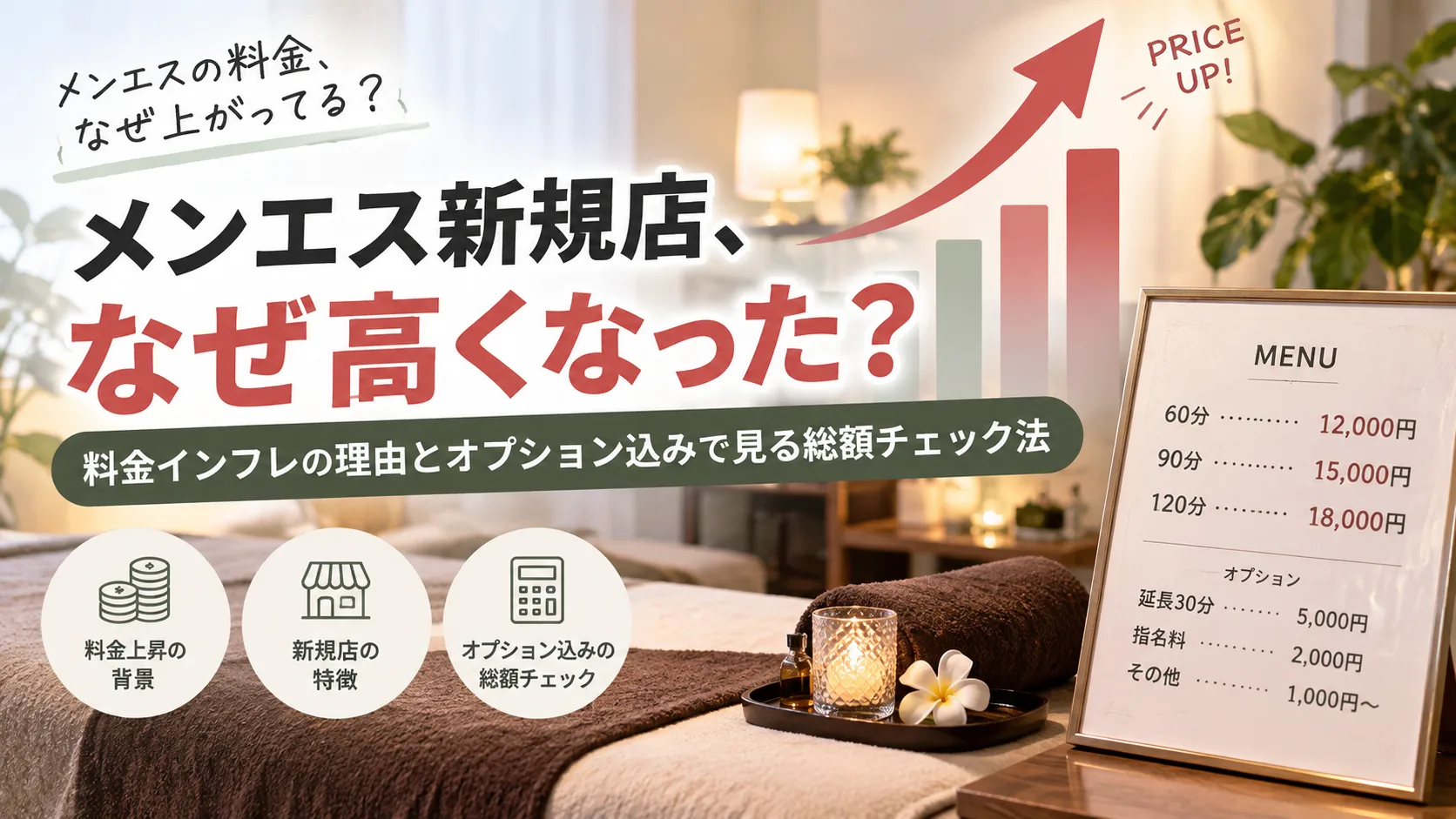
Why Are New Men's Esthe Salons So Expensive Now? Price Inflation and How to Compare the Real Total
Why prices, therapist credentials, and interiors at new men's esthe salons have been climbing over the past year or two, and why base prices tend to rise while add-on options stay the same. Includes what to check to compare the real total cost.
What was updated
Added a note on checking whether a therapist tends to suggest personal add-ons.
What this article covers
Have you noticed that recently opened salons seem to cost more than they used to? This article covers:
- What's inflating at new salons — price, therapist credentials, and interiors
- Why this inflation is said to be happening
- Why base prices tend to rise while add-on options stay the same
- What to check so you can compare the real total cost
This article includes editorial opinion
What follows isn't based on an industry-wide survey — it reflects things the editorial team has heard and commonly discussed views within the industry. It doesn't apply to every new salon, and it isn't about any specific business.
Short answer: a higher price doesn't automatically mean a better experience
Over the past year or two, price, therapist credentials, and interiors at new men's esthe salons are all said to be trending upward. But a higher price doesn't necessarily mean fewer add-on fees or a clearer, more transparent experience. In fact, it's said to be common for just the base price to rise by several thousand yen while the add-on system stays exactly the same as before. Comparing the real total cost matters more than ever.
1. What's said to be inflating
Course prices
A 90-minute session used to run around ¥15,000, but at newer salons, prices above ¥20,000–25,000 for 90 minutes are said to be increasingly common. Branding as a "premium" or "luxury" salon is said to be part of how this higher pricing gets justified.
Therapist credentials and profile
As hiring competition has intensified, more salons are said to be featuring therapists with strong personal branding — a modeling background, competition wins, or similar — as their main draw. Some salons reportedly poach popular therapists from other shops with strong guaranteed-pay offers.
Interiors, amenities, and location
More salons are said to be opening in high-rise or newer luxury apartments with concept-designed rooms, rather than a unit in an ordinary mixed-use building. Some accounts point to real increases in spending on oil quality and equipment.
The sheer number of new salons
With information about how profitable running a men's esthe salon can be, plus the spread of franchise and how-to-open training programs, more people from outside the industry are said to be opening salons, leading to oversupply in major areas.
2. Why this inflation is said to be happening
Intensifying portal-site and social media marketing
Portal-site ranking placement and social media marketing costs have gone up, which is said to push new salons toward loud "premium" or "high-spec" branding just to avoid getting buried in the listings.
Rising cost of hiring therapists
With so many salons competing for the same pool of therapists, salons are said to need higher commission rates or stronger pay guarantees to attract staff — a cost that tends to get passed on to pricing.
A split between "technique-focused" and "looks-and-presentation-focused" salons
The market is said to be splitting into salons that lead with genuine technical skill and ones that lead with looks and atmosphere — with both sides pushing toward higher perceived value and higher prices.
3. Why base prices rise while add-on options stay the same
Some customers report going to a new salon hoping for clear, all-in pricing, only to find the base price up by several thousand yen with the same old add-on negotiations still in place. A few explanations come up often:
Rising fixed costs
Rent and utilities in central areas, the cost of treatment oil and linens, and portal-site advertising fees are all said to have gone up — and that cost tends to flow straight into the base price.
Competition for therapists
Attracting good therapists is said to require higher commission rates or stronger guarantees, and that rising labor cost tends to show up directly in pricing.
Industry structure that resists all-inclusive pricing
Add-on fees often function as direct incentive pay for therapists, so switching to a single flat rate is said to risk popular therapists feeling their extra effort isn't rewarded — leading some to leave. There's also a incentive to keep the *listed* base price low on portal sites, which is another reason the add-on structure tends to stick around.
4. What this means for you as a customer
The "new-salon lottery" risk
Even when pricing and interiors look polished, therapist training may not have caught up yet, which raises the risk of technique or service that doesn't match the price tag.
Established salons getting squeezed out
While flashy new salons multiply, some solid mid-tier and independently run salons that can't keep up with rising ad and guarantee costs are said to be struggling or closing. Put differently, a salon that's stuck around without the flash may have earned that longevity for a reason (see our guide on finding a hidden-gem salon).
What to check to compare the real total cost
Rather than judging by price alone, checking the following can help you avoid ending up paying more than expected:
- Exactly what's included in the base price (duration, areas covered, oil type, etc.)
- Whether a nomination fee is charged separately
- What the main add-on options cost
- The per-unit rate for extending the session
- Any surcharges for transportation, late-night hours, and so on
You can also get a sense of the full course-plus-options total from our pricing guide or the price calculator tool.
Ask again when you call or message to book, even if you're sure you already know
Even if you feel you've already worked it out from the official site, it's worth asking again when you call or message to book — exactly what's included in the base price, and what add-ons might be suggested on the day.
Confirming it out loud, even when you think you already know, helps prevent a "that's not what I was told" mismatch once you're there. Taking the extra minute to ask is a small habit that ends up protecting you.
In short: look at whether the total and the experience actually match
Rising price, therapist credentials, and interior spending at new salons are said to reflect real structural pressures — rising fixed costs and competition for therapists among them. But a higher price doesn't automatically mean a better experience. Rather than judging by the base price alone, checking the real total, including add-ons, against the actual technique and service you receive is the better way to avoid disappointment.
Frequently asked questions
Should I avoid new salons altogether?
Not necessarily. Plenty of new salons genuinely deliver solid technique and service. Rather than judging by price alone, it's worth checking how specific the reviews are and how clearly the official information is presented.
Can I trust a salon that advertises "all-inclusive pricing"?
All-inclusive pricing is genuinely easier to understand as a customer. That said, always confirm exactly what is and isn't included — extensions, nomination fees, and similar charges — before booking.
It's also worth checking, whether you're nominating a therapist or getting whoever's assigned that day, if reviews mention that particular therapist tends to suggest personal add-ons during the treatment. Even at a salon with all-inclusive pricing, an individual therapist may still bring up extra suggestions of their own once the session is underway.
Does a higher price mean better technique?
Not necessarily, it's said. Price is also shaped by things like therapist branding and interior costs, so if technique matters most to you, how specific the reviews are and how clearly the treatment is explained are worth weighing alongside the price.