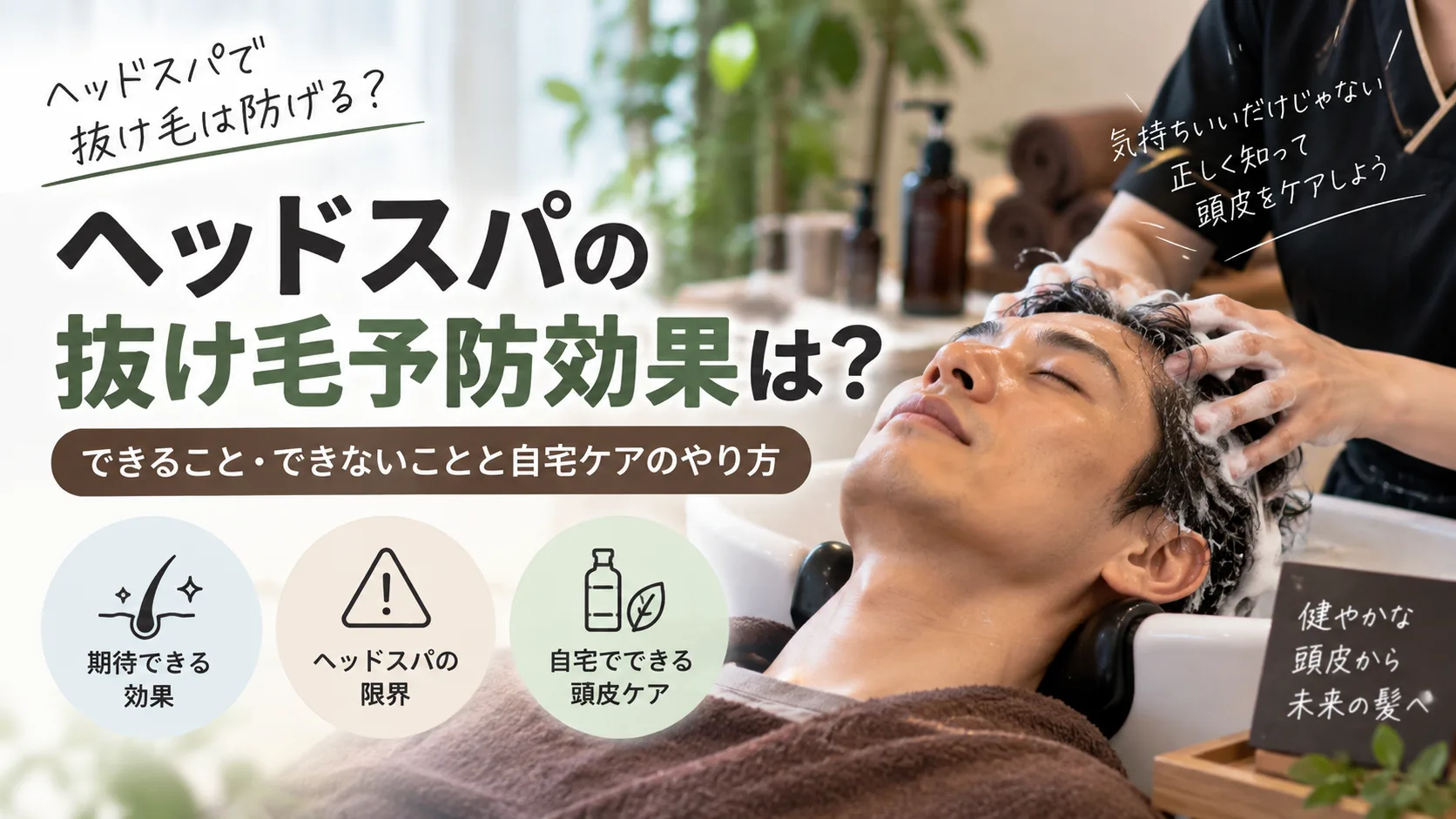
Does a Head Spa Help Prevent Hair Loss? What It Can and Can't Do, Plus At-Home Scalp Care
What a head spa can realistically do for hair loss prevention — better blood flow, pore care — and what it can't do, like AGA. Includes an at-home scalp massage routine and how to choose a scalp lotion.
What was updated
Added a medicated hair-growth tonic affiliate product.
What this article covers
Ever wondered whether a head spa actually helps with hair loss? This article covers:
- What a head spa is said to help with for hair loss prevention
- What a head spa can't do
- An at-home scalp massage routine
- How to choose a scalp lotion or tonic
This article includes editorial opinion
What follows isn't a guarantee of medical treatment effects — it reflects ideas commonly discussed in the scalp-care field and information the editorial team has researched. If hair loss or thinning is a real concern, please consult a medical professional rather than relying on self-treatment.
Short answer: a head spa is defense, not offense
A head spa isn't said to treat hair loss directly or produce fast, active regrowth. What it is said to offer is a preventive effect — helping maintain a healthy scalp environment where hair loss is less likely to happen.
If you go in expecting the same kind of active treatment as a hair-growth medication or AGA treatment, it may feel underwhelming. But thought of as maintenance for the "soil" hair grows from — the scalp — it's said to be a reasonable, worthwhile habit.
3 effects a head spa is said to offer
Better blood flow, so nutrients reach the hair more easily
Hair is said to be built by hair-matrix cells at the root, which draw nutrients from the bloodstream. When the muscles of the scalp loosen and blood flow improves, nutrients are said to reach the hair root more easily, which is said to help prevent thinning hair and hair loss.
Gently clearing built-up oil and debris from pores
Removing pore buildup that shampoo alone can't fully clear — using dedicated oils or cleansers — is another part of what a head spa does. This is said to help prevent pore inflammation and support a healthier hair growth cycle.
Relaxation that's said to ease stress-related effects
Soothing pressure and aromatherapy scents are said to help shift the body into a more relaxed state. Ongoing stress and tension are said to constrict scalp blood vessels, so the relaxation from a head spa is described as an indirect, supportive form of prevention.
What a head spa can't do
Stop the progression of AGA (male pattern hair loss)
AGA, a common cause of hair loss in men, is said to be driven by male hormones. Loosening the scalp during a head spa doesn't change hormone balance itself, so it isn't expected to stop progressive hair thinning. If this is a concern, seeking AGA treatment from a medical provider is the more realistic option.
Regrow hair from a follicle that's already inactive
Growing new hair from a follicle that has already stopped functioning is also said to be beyond what a head spa alone can do. This, too, is a case where consulting a medical professional is the practical path.
2 tips for getting more out of it
Don't scrub too hard
Scrubbing the scalp hard, or applying painful pressure, is said to risk damaging the tiny blood vessels in the scalp rather than helping. A gentle pressure that leaves a warm, pleasant feeling is said to be the better target.
Don't worry too much about shedding right after a session
It's common to notice a bit more hair falling out on the day of a head spa. This is usually just hair that had already reached the end of its natural cycle being dislodged by the massage, not new hair loss — so it's not typically something to worry about.
An at-home scalp massage routine
For a self-massage at home, the trick is said to be moving the scalp over the skull rather than scrubbing it, and doing it without your nails. Doing this in the bath, or right after applying a scalp lotion post-shower, is said to help blood flow even more.
1. Lift the temples
Place the heel of your palm against your temples, just above your ears. Apply firm pressure and gently work the scalp in a circular, lifting motion for 10–15 seconds. This area tends to tense up first from eye strain and stress, so loosening it here is said to leave you feeling noticeably refreshed.
2. Sweep from the hairline toward the crown
Place your fingertips (all but your thumbs) at your hairline, being careful not to dig in with your nails. Slowly push and lift the scalp toward the crown of your head. Repeat this 3–5 times, moving slightly across the hairline each time.
3. Knead from the back of the head to the base of the neck
Place your thumbs at the base of your neck, at the dip near your hairline, supporting your head with your other fingers. Apply comfortable pressure while working in a lifting, circular motion. This area has major blood vessels connecting the neck to the head, so working it here is said to leave your whole head feeling pleasantly warm.
4. Press the Baihui point
Find the point at the crown of your head where a line between your ears crosses the center line of your face, and place your middle finger (or a few fingertips) there. Exhale as you slowly apply pressure for 3–5 seconds, then inhale as you slowly release. Repeating this about 3 times makes for a good finishing touch.
Things not to do
- Scrubbing hard with your nails: said to damage the scalp and pores, which can trigger inflammation or hair loss rather than prevent it.
- Applying painful pressure: forceful kneading is said to risk damaging the scalp's fine blood vessels. Aim for pressure that feels like a good, satisfying ache — not pain.
- Going too long: 2–3 minutes per session is said to be plenty. Consistency day to day matters more than duration.
How to choose a scalp lotion or tonic
Using a scalp lotion or tonic during an at-home massage is said to improve glide and reduce friction damage. Choose based on your current scalp condition and what you most want to address.
If dryness or tightness is the concern
Moisture-focused formulas with ingredients like hyaluronic acid or ceramides, in a lotion-type product, are said to work well. Choosing one without a strong cooling agent like menthol tends to be gentler on the scalp.
If preventing hair loss and improving circulation is the goal
Products often called "medicated hair-growth tonics," containing ingredients like swertia extract, ginseng extract, or niacinamide (vitamin B3), tend to be the common choice. Combined with massage, this is said to offer a compounding effect on circulation.
If oiliness or odor is the concern
Products formulated for oil control with antibacterial or deodorizing ingredients are said to be a good fit.
Choosing by format
A spray-nozzle type is said to be easy to apply precisely, making it convenient before a massage. Aerosol/jet types deliver a stronger, more refreshing burst but often contain more alcohol, so check the ingredient list if dryness is a concern.
A note on use
A high alcohol (ethanol) content is said to potentially worsen dryness when your skin is sensitive or during drier seasons. If that's a concern, look for products labeled alcohol-free or low-irritation. The trick for application is said to be applying it after a post-bath towel-dry, parting your hair to apply it directly to the scalp rather than the hair itself.
Starting with a simple medicated scalp lotion available at a drugstore — one formulated for dry, sensitive skin, or one containing swertia extract — is a reasonable way to begin.
In short: a head spa is worth keeping up as defensive scalp care
A head spa is said to make sense as a preventive habit that keeps the hair you already have healthy and supports a scalp environment less prone to hair loss. If AGA treatment is the offensive play, a head spa or at-home scalp massage is the defensive one — building a better environment over time. Working it into your routine, without overdoing it, is a reasonable way to approach it.
Frequently asked questions
Can a head spa alone treat AGA?
It isn't expected to have a treatment effect on its own, it's said. Since AGA is a progressive, hormone-driven condition, consulting a medical professional is recommended if it's a concern.
How often should I do an at-home scalp massage?
Around 2–3 minutes a day is said to be a reasonable target — consistency tends to matter more than any single session.
Does scalp massage cause more hair loss?
You may notice a bit more shedding right after a session, but this is usually hair that had already reached the end of its cycle being dislodged, not new hair loss. As long as you're not using excessive force, it's generally not something to worry about.