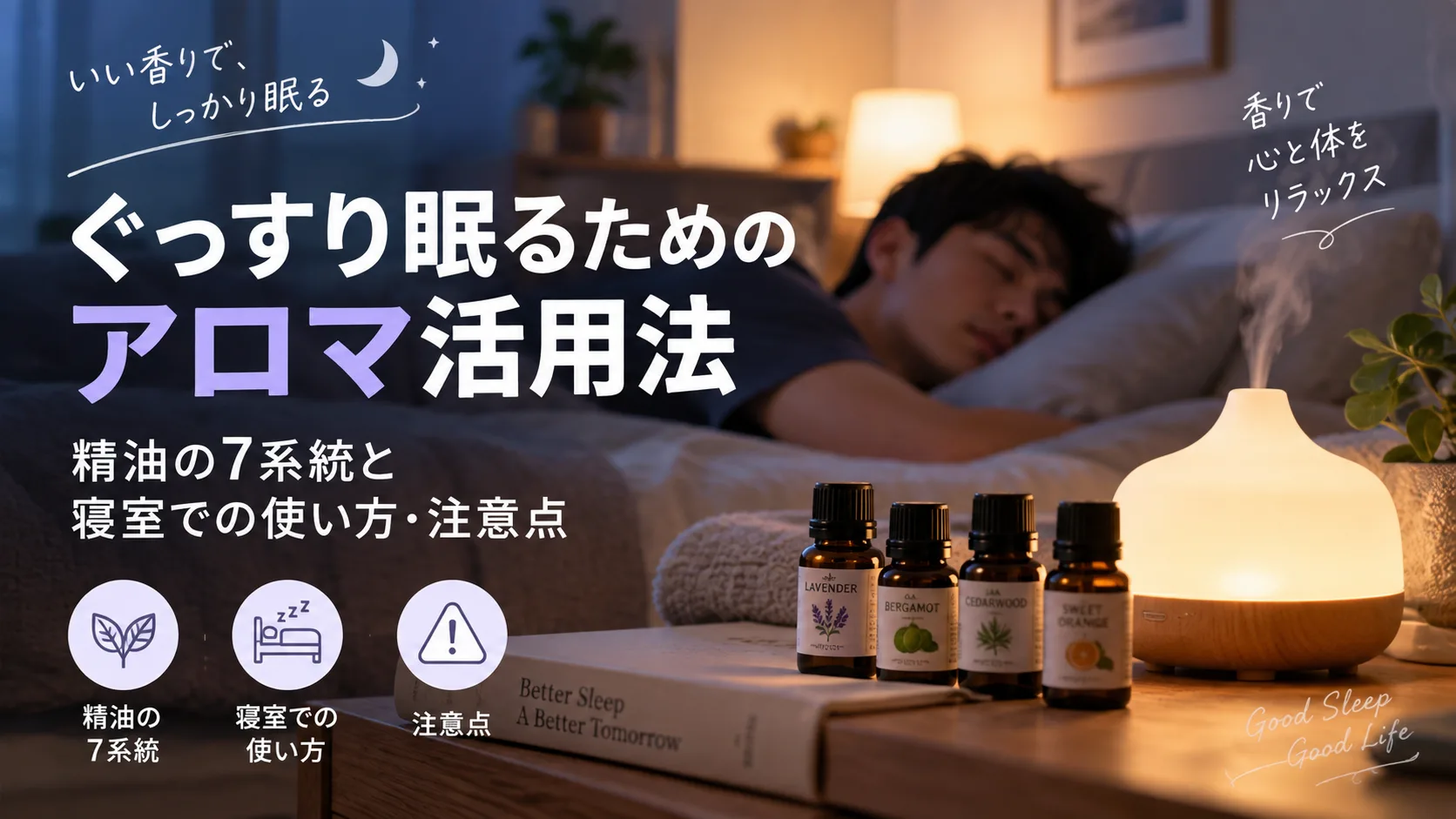
Aromatherapy for Better Sleep: The 7 Families of Essential Oils and How to Use Them Safely
A guide to the 7 families of essential oils, which scents are commonly recommended for sleep, and how to use aroma safely in the bedroom.
What was updated
Added a waterless aroma diffuser and aroma spray set for bedroom use.
What this article covers
You've probably heard that burning aroma before bed can help you fall asleep more easily. This article covers:
- The 7 families of essential oils and their characteristic scents
- Essential oils commonly recommended for sleep, plus blend ideas
- How to use aroma safely in the bedroom
This article includes editorial opinion
What follows isn't an established medical treatment — it reflects ideas commonly discussed in the aromatherapy field and information the editorial team has researched. Effects vary by individual, and if sleep issues persist, please consult a medical professional rather than relying on self-treatment.
Essential oils are grouped into 7 families by scent character
Essential oils used in aromatherapy are said to fall into roughly 7 families, based on the part of the plant they're extracted from and their scent character. Each family is associated with a different impression and expected effect.
Citrus
Examples: sweet orange, grapefruit, bergamot, lemon
A fresh, broadly appealing scent said to be popular for lifting mood and refreshing the mind.
Floral
Examples: lavender, rose, jasmine, geranium
An elegant, floral scent often chosen for stress relief and supporting the autonomic nervous system.
Woody
Examples: hinoki cypress, cedarwood, tea tree, eucalyptus
A calming scent reminiscent of a forest walk, sometimes used for focus or relaxation.
Herbaceous
Examples: peppermint, rosemary, clary sage, marjoram
A crisp, refreshing scent said to be used for shaking off drowsiness or mental fatigue.
Oriental (exotic / resinous)
Examples: sandalwood, frankincense, patchouli
An exotic, deep scent said to suit meditation and quiet evening time.
Spice
Examples: cinnamon, black pepper, ginger
A spicy, stimulating scent sometimes used as an accent when you want to feel warmed up or re-energized.
Resin
Examples: benzoin, myrrh
A sweet, heavy scent said to be favored for calming the mind.
Blend ideas if you're not sure where to start
- Sleep and relaxation: lavender + sweet orange
- Stress relief and mood change: bergamot + geranium
- Focus and mental clarity: rosemary + peppermint
Why aroma before bed is said to help with sleep
Scent inhaled through the nose is said to reach parts of the brain associated with the autonomic nervous system and emotion. This is said to help the parasympathetic nervous system (the "rest and relax" mode) take over, easing physical and mental tension and making it easier to fall asleep — an idea commonly discussed in aromatherapy. That said, the exact mechanism linking scent to the autonomic nervous system isn't fully established in medical science, so it's worth keeping that in mind.
Commonly cited benefits include:
- Repeating the same scent as a cue is said to help the brain associate it with sleep, shortening the time it takes to fall asleep
- A more balanced autonomic nervous system is said to reduce waking up during the night
- The day's tension is said to ease, allowing for deeper breathing
Essential oils commonly recommended for the bedroom
- Lavender: said to help balance the autonomic nervous system and ease anxiety — a classic choice for sleep
- Sweet orange: a warm scent said to have a calming effect, and a popular blend partner with lavender
- Bergamot: among citrus scents, said to be especially relaxing, and a good fit when your mind is racing
- Hinoki cypress / cedarwood: said to bring the sense of calm associated with a walk in the forest
Safety notes for using aroma at night
Avoid open-flame candles or oil burners
An open flame carries a fire risk while you sleep. A timer-equipped electric diffuser, or an aroma stone (a porous stone you add a few drops of oil to), are safer choices for the bedroom.
Don't make the scent too strong
A scent that's too strong can end up stimulating the brain rather than relaxing it, which can work against falling asleep. A subtle scent — around 1 to 2 drops — is generally the right amount.
Check dilution guidance before applying oil to skin
If you apply essential oil directly to skin, always follow dilution guidance appropriate to that use. For simply enjoying the scent (aromatic diffusion), a diffuser or aroma stone is the basic approach.
From our editorial team: the time we fell asleep during an aroma massage
Someone on our editorial team has genuinely fallen asleep mid-treatment during an aroma massage — the kind of deep sleep where you don't notice the session has ended until it's over. If that sounds familiar, you're probably not the only one.
Using a diffuser at home works well on its own, but it's also worth visiting an aroma salon in person and letting a conversation with the therapist guide you toward a scent that suits you. Scent preferences vary a lot from person to person, so use that conversation as a chance to find the one that fits you best.
In short: knowing the families makes it easier to choose
Essential oils fall into 7 families, each associated with a different impression and expected effect. For sleep, relaxing scents like lavender or sweet orange are a reasonable starting point. In the bedroom, choose a flame-free method and keep the scent subtle for a safer experience.
Frequently asked questions
How much essential oil should I use?
For a diffuser or aroma stone, starting with 1 to 2 drops and adjusting based on scent strength is generally recommended.
Is it okay to use aroma every night?
Adjusting based on how you feel is generally fine, but if you feel you've gotten used to a scent, trying a different family is one option.
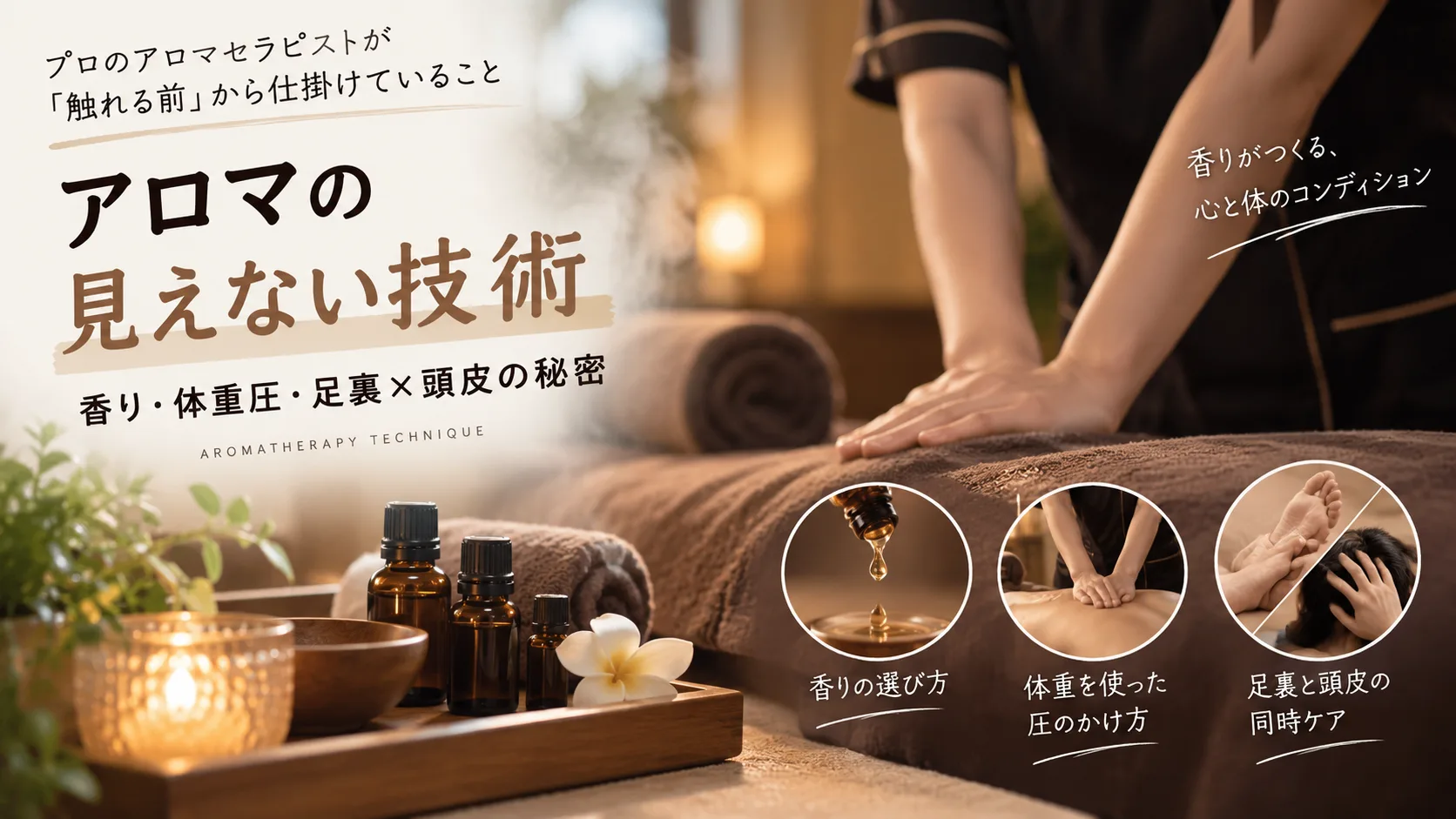
Is this related to the techniques used in aromatherapy salons?
Enjoying essential oils at home and receiving a professional aromatherapy treatment serve different purposes. For the salon side of things, see our guide on what a professional aromatherapist does before they even touch you.