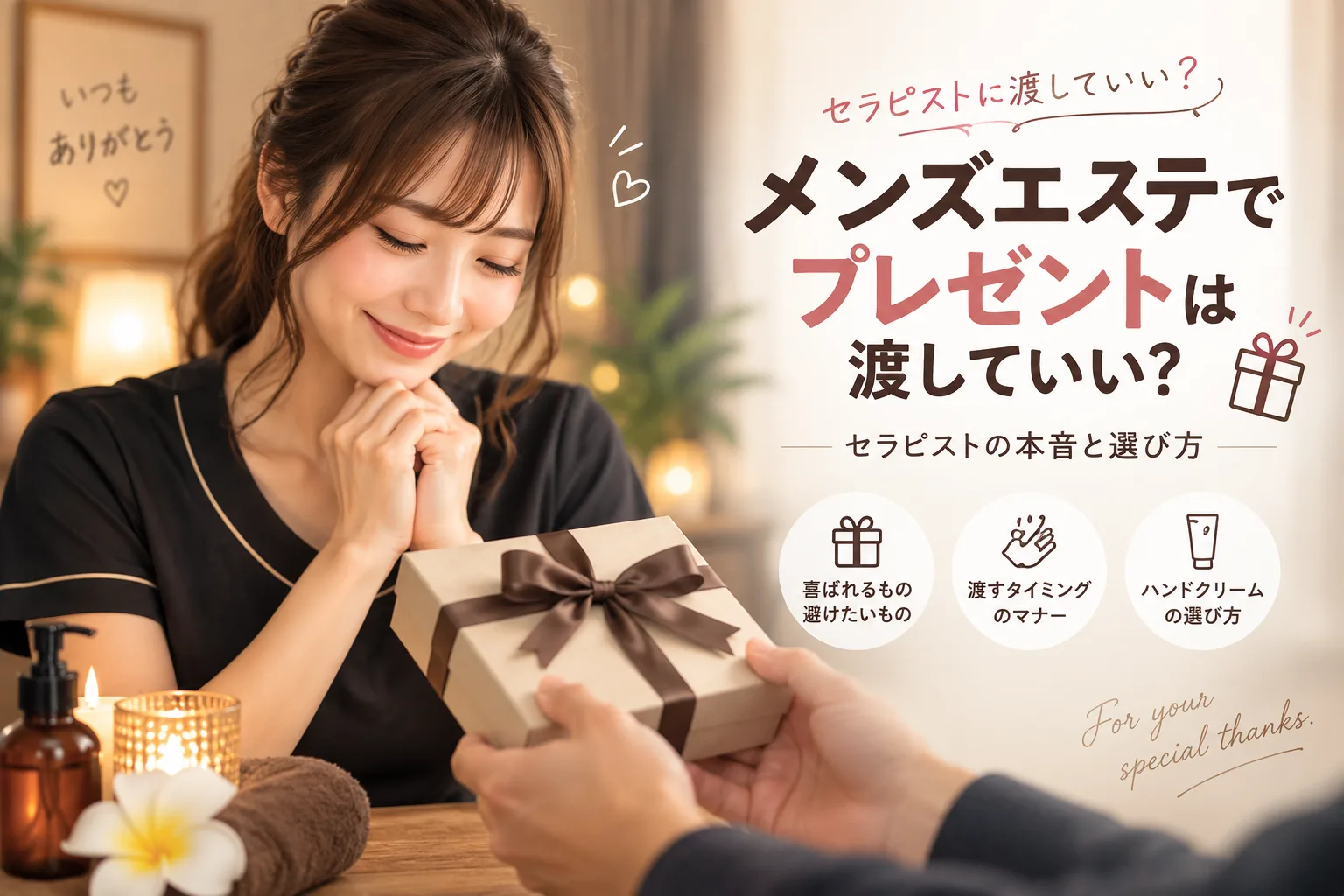
Is It Okay to Give a Therapist a Gift at Men's Esthe?
Whether giving a small gift to a men's esthe therapist is appropriate, what's generally welcomed versus awkward, gift-giving etiquette, and how to choose a hand cream.
What was updated
Added a specific hand cream example (Cellcode Hand Cream Exorich).
What this article covers
Have you ever wondered whether it's strange to give a men's esthe therapist a small gift? This article covers:
- What to check before bringing a gift
- What's said to be welcomed versus awkward from a therapist's perspective
- Three etiquette points for giving a gift smoothly
- What to look for in a hand cream specifically
Short answer: check the salon's policy first; keep it light and consumable
Giving a small gift to a therapist isn't unusual, based on what we've come across. That said, some salons prohibit personal gifts entirely as house policy. Before acting on the impulse to bring something, confirming the official rule is the first step.
Even where it's allowed, something light and consumable — rather than expensive or heavily symbolic — is generally considered the safer choice. Anything too costly or meaningful can end up putting the recipient in an awkward position.
This article includes editorial opinion
This isn't based on an industry-wide survey — it reflects things our editorial team has heard, and it won't apply to every therapist or salon.
Check first: some salons ban personal gifts entirely
Some men's esthe salons prohibit therapists from accepting personal gifts as a matter of policy. Where that rule exists, attempting to give something can put the therapist in an uncomfortable position or even count as a policy violation.
If you're considering it, ask reception or staff whether gifts are allowed before handing anything directly to a therapist.
What therapists are said to think, honestly
Generally well-received
- Something that acknowledges the physical demands of the job (e.g., "I figured your hands might get dry" or "you're on your feet all day")
- Something easy to consume, like snacks, drinks, or practical care items
- Something that reflects a preference mentioned in passing conversation
Said to feel uncomfortable or raise concern
- Anything that feels like it's expecting something in return (personal contact information, special treatment)
- Anything heavy or bulky that's hard to carry home
- Anything too expensive (it can create pressure, and some salons simply can't accept it under their rules)
- Homemade food or opened items (often declined for hygiene and safety reasons)
Rather than treating a gift as a way to get closer to someone, framing it as a small, low-stakes thank-you for the treatment itself is said to work best for everyone involved.
A rough guide to appropriate gifts
| Category | Examples | General tendency |
|---|---|---|
| Generally well-received | A drink gift card (e.g., via a messaging app), bath salts, individually wrapped snacks, an inexpensive hand-care item (roughly ¥500–2,000) | Easy to carry, easy to use up, and unlikely to feel like an obligation |
| Depends on the relationship | Hand cream or lip balm (roughly ¥3,000–5,000) | More likely to be welcomed once you've built some rapport over repeat visits; can feel like too much on a first encounter |
| Best avoided | Jewelry, branded bags, large sums of cash, homemade food, home decor items, large bouquets of fresh flowers | Said to raise concern, or may violate a salon's own policy |
Policies on what can be accepted vary by salon — treat this as a general reference point, not a rule that applies everywhere.
Three etiquette points for giving a gift smoothly
- Don't give a gift on your first visit, or your second or third: waiting until you've built some rapport over repeat visits is said to reduce the risk of it being read as expecting something in return.
- Frame it explicitly as a thank-you: something like "you're always so thorough" or "my shoulders felt so much better last time" is said to make it easier for a therapist to accept comfortably.
- Think about how easy it is to carry: therapists often commute by train or bus, so something that fits in a bag and isn't heavy is a basic requirement. A large gift bag can also draw attention from other staff or customers.
If you're choosing a hand cream
Hand-care items are said to be one of the more practical, well-received gift categories. Therapists wash their hands frequently and work with oil throughout the day, which is said to make dry hands a common issue. That said, there are types that are said to be hard to actually use on the job, so it's worth choosing carefully.
What's said to work well
- Unscented, or very lightly scented: a strong scent during treatment could clash with the salon's oil scent or unscented policy and bother clients. Unscented products are the easiest to use on shift.
- A non-greasy texture: anything that leaves a residue can get in the way of using a phone or handling towels and supplies. Hyaluronic-acid or ceramide-based creams that absorb quickly are said to be appreciated.
- A portable size: a small tube (roughly 30–50g) that fits in a salon pouch or bag is said to be convenient.
What's best avoided
- Strongly scented products (preferences vary a lot, and they're hard to use on shift)
- Heavy, greasy formulas (inconvenient to use between treatments)
Generally speaking, unscented, low-irritant hand creams with a light finish tend to be well received. Check the ingredient list and packaging size when choosing a specific product.
One example that fits these criteria is the Cellcode Hand Cream Exorich, an unscented, 50g tube moisturizer formulated with human stem-cell-derived exosomes, marketed as a light, non-sticky, Japan-made cream. It's sold on a Japanese retail site and ships domestically, so it mainly suits residents or travelers with a Japan-based delivery address.
Frequently asked questions
Is giving a gift considered bad manners?
Not universally, but some salons prohibit it as a matter of policy. Checking with reception or staff beforehand is the safest approach.
What about giving cash?
A tip on top of the regular course fee isn't common practice at men's relaxation salons in Japan. Giving cash directly can make things awkward or violate house rules, so it's generally best avoided.
After how many visits is it okay to give a gift?
There's no fixed number, but waiting until you've built some rapport over repeat visits is said to reduce the chance of it being misread. Avoid an expensive gift on your first, second, or third visit.
Related English guides
- 8 awkward questions about men's esthe in Japan
- After a men's relaxation session in Japan: shower and thank-you etiquette
- Therapist age groups and how to choose a salon
- 3 small things regulars notice about men's esthe
- Frequent men's esthe visits and trouble getting aroused with a partner
- Why do therapists ask "why did you book me?"
- The real technique behind men's esthe's famous "leg wrap" move
Read next
Related guides
Switching Therapists at the Same Salon: How to Avoid the Awkwardness
What reportedly happens when you switch to a different therapist within the same men's esthe salon, and practical ways to avoid awkward run-ins and questions.
3 Questions You Shouldn't Ask a Therapist: Identity, Dating and Real Names
Questions that are best avoided even when conversation flows well at a men's esthe salon — about a therapist's identity, dating life, or real name — and why they tend to raise a therapist's guard.
Exercise Habits Linked to Blood Flow: Basics for Anyone Concerned About Erectile Function
Male erectile function is said to be linked to blood flow and lower-body muscle strength. An overview of commonly discussed exercise habits — squats, pelvic floor training, cardio — and signs it's time to see a doctor.