Why Do Therapists Ask 'Why Did You Book Me?' and 'How Often Do You Come?'
Why men's esthe therapists often ask why you chose them and how often you visit, explained through treatment customization, repeat-business strategy and safety screening. Also covers the difference between salon training and individual technique.
What was updated
Published a look at why therapists ask about nomination reasons and visit frequency, and how it relates to salon training.
What this article covers
If you've been asked "Why did you choose to book me?" or "How often do you come here?" during a session, you're not alone. This article covers:
- The likely reasons behind these questions
- How they relate to salon training and business strategy
- Smart ways to answer if you'd rather keep it brief
This article includes editorial opinion
What follows isn't based on an industry-wide survey — it reflects things the editorial team has heard and commonly discussed ideas about service-industry practice, and it won't apply to every therapist or salon.
Short answer: it's said to serve three purposes beyond small talk
Asking about your booking reason or visit frequency does double as icebreaker small talk, but that's reportedly not the whole story. It's also said to help tailor the treatment to what you're looking for, to inform how to approach a future visit, and to gauge whether you're new to this kind of service so the therapist can guide you appropriately and safely.
Why therapists ask about your reason for booking
One view: it informs how the treatment is approached
Whether you say "the photos had a nice atmosphere," "the profile mentioned strong pressure," or "the reviews mentioned a careful touch," your answer is said to hint at what you're looking for that day — appearance, technique, or conversation. Some therapists reportedly use this to decide between a firmer, more focused treatment or a gentler, more relaxing one.
One view: it helps build toward a future visit
Knowing your reason for booking can make a future visit feel more personal — for example, "I focused on what you mentioned enjoying last time" — which is said to help build rapport over repeat visits.
Why therapists ask how often you visit
One view: it distinguishes newcomers from regulars
How much explanation someone needs — of pricing, of the flow of the session — tends to differ depending on whether they're new to this kind of service or a regular. Adjusting the level of explanation based on this is said to be a common part of tailoring the experience.
One view: it helps gauge timing for a future visit
Knowing how often someone visits is said to help a therapist gauge how to approach mentioning availability — a light "I'll be here again next week" for someone on a weekly rhythm, versus simply waiting for someone who treats it as a monthly treat, without pushing.
It can also just be conversational icebreaking
In a private room where two people who've just met spend an extended time together, these questions are also said to function as a familiar, low-risk way to ease initial tension. There's no need to overanalyze it — it can simply be part of natural small talk.
Is this salon training, or the therapist's own approach?
These questions are said to come from a mix of salon-provided training and a therapist's own individual style.
As part of new-therapist training
A sequence like "greeting → checking in on how you're feeling → asking about the booking reason → asking about visit frequency" is said to sometimes be taught during training as a reliable way to ease into the session.
As a repeat-business strategy
Building repeat, nominating customers tends to matter more to both the salon and the therapist than one-off visits, and asking about booking reasons and frequency is said to be a basic part of that strategy in some training programs.
As a way to screen for newcomers, for everyone's safety
Men's esthe is a relaxation-focused service, not a sexual one. Asking about visit frequency is said to help identify first-time visitors early, so the therapist can clearly communicate house rules (like limits on physical contact) — a practice framed as protecting both the client and the therapist.
Experienced or popular therapists are said to weave these questions more naturally into conversation, rather than following a script.
Smart ways to answer
Answering honestly and simply is completely fine. If you'd rather keep it brief, here are a couple of easy responses:
- If asked why you booked: "The profile just seemed like the best fit."
- If asked how often you visit: "Just whenever I feel like it, really."
Whether you go into detail or keep it short is entirely up to your mood and comfort level that day.
Frequently asked questions
Is it rude not to answer in detail?
Not at all. A brief answer is completely fine if you'd rather not elaborate.
Is asking about frequency a sales tactic?
Pushy solicitation or pressuring a future booking is generally considered poor etiquette. Being asked about frequency doesn't obligate you to commit to anything.
Can I just say I'd rather not talk about it?
Yes — something like "I'd just like to relax quietly today" is a perfectly reasonable way to steer away from conversation.
Related English guides
- Is it okay to give a therapist a gift at men's esthe?
- 8 awkward questions about men's esthe in Japan
- Therapist age groups and how to choose a salon
- 3 small things regulars notice about men's esthe
- What therapists really think? 5 things they don't say out loud
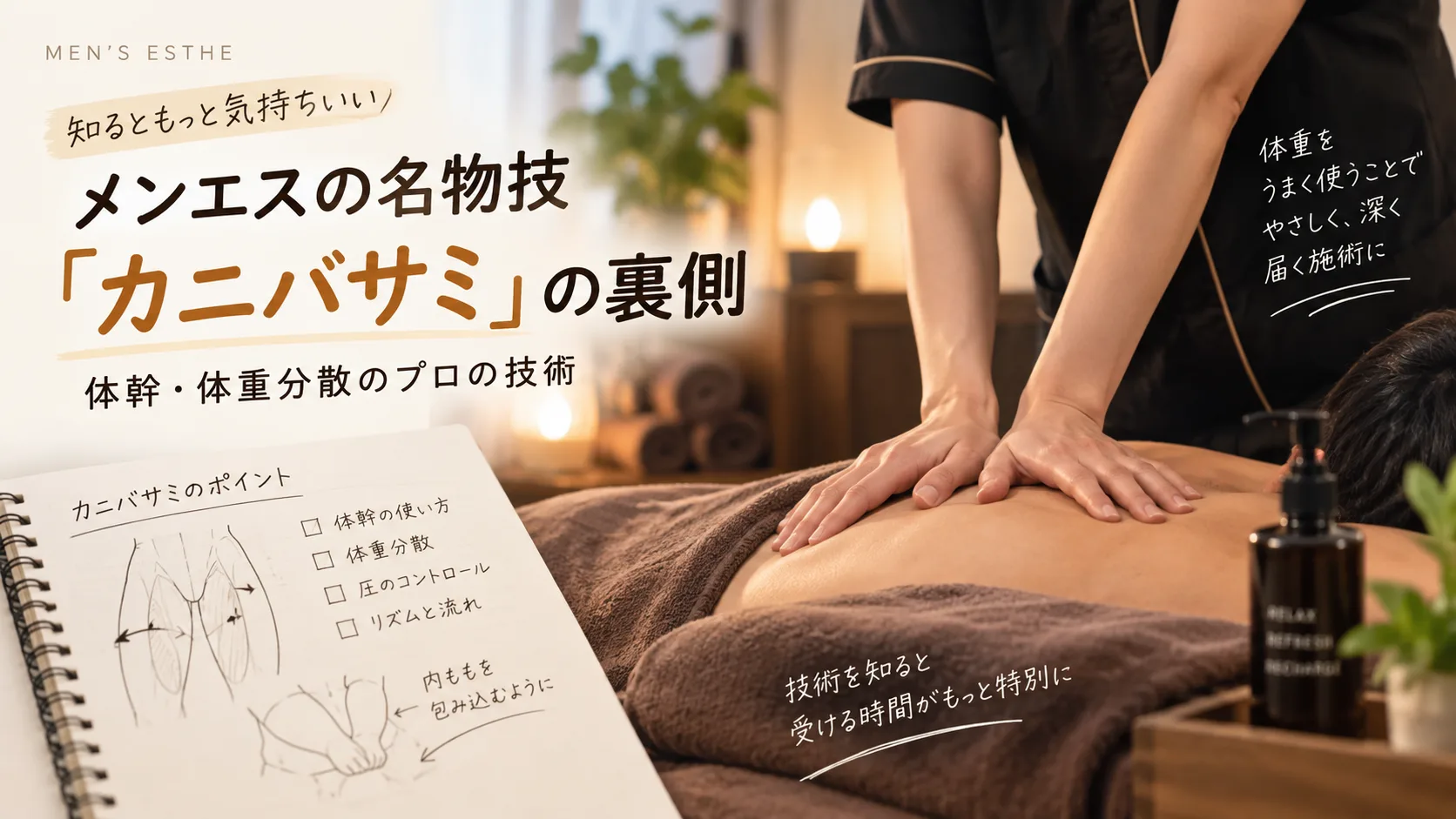
- The real technique behind men's esthe's famous "leg wrap" move
- 3 questions you shouldn't ask a therapist: identity, dating and real names
- Switching therapists at the same salon: how to avoid the awkwardness